Getting ready for the beginning of a new school year can be hectic. There are a lot of things that a teacher will need to do to be ready, and it seems like every year I always forget something. To help me be ready for the new school, I made a list to help me stay on track, be organized, and stay stress-free.
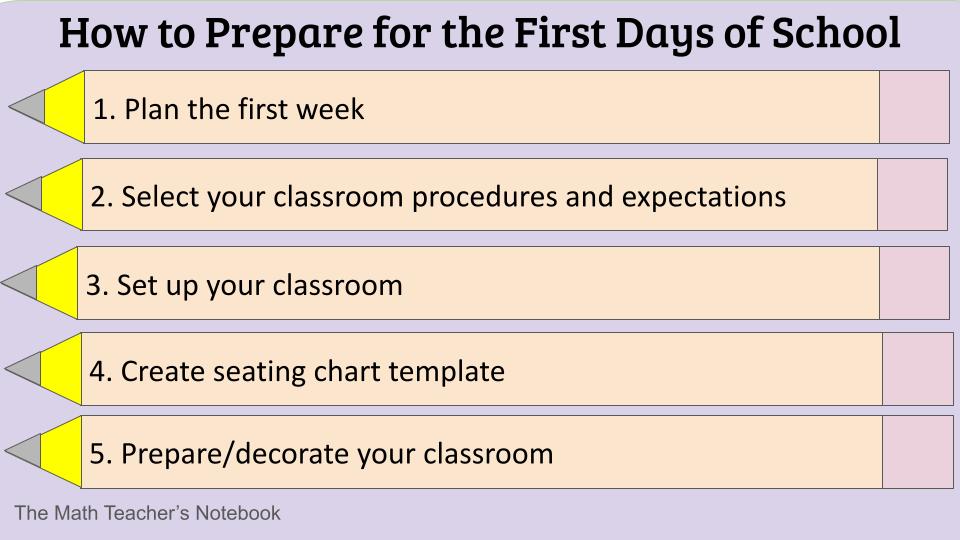
1. Plan the first week.
My school sites have often provided time for teachers to plan for the new school year at the start of summer vacation. This is optional, but paid time, and if it’s offered, I plan to attend. I find this planning time beneficial, especially when my school has adopted a new textbook, when I’ve changed grade assignments, or school sites. During this time, I’ve planned with my grade level team, reviewing the first unit in our pacing guide, creating activities, assignments, homework, assessments, etc for the first weeks/unit of the school year. I use PowerPoint for teaching and I create the presentation to have ready. When I haven’t had planning time offered, I’ve tried to do a little of this planning during my conference periods before the semester ends. Yes, this can be challenging because of being teacher tired at the end of the school year, but it helps to have a little planning completed before the first days of school. In the past, I’ve also planned days before the first day of school. I wouldn’t recommend doing this because it does shorten the summer break, which I really enjoy, but it’s the last opportunity to prepare for the first days of school.
2. Select your classroom procedures and expectations.
Every teacher has their way of doing things in their classroom, and your new students will need to learn them all. Review with yourself how you want things organized and done. How will students enter your classroom, will you have them wait at the door and you’ll greet them or do they just walk in? What will students do at the beginning of the period? How will students let you know they need to sharpen their pencil or go to the restroom? What is the procedure for submitting work? How will students be dismissed? When will students get and use other materials in your classroom? This is a good time to change things up if you want to try something new or to bring back things you used to do in the past. For me, it seemed that after teaching online I had to relearn some of the procedures I had when students were in person. You know your personality best, but you need to think about how you want your class structured to help things run smoothly and you’ll need to review and teach these to your students.
3. Set up your classroom.
Students Seating– The classroom size and the furniture available for student seating will influence how you set up your classroom. Hopefully you’ll see your classroom before the school year begins so you can plan ahead of time, but if not I recommend figuring out how you want to seat students, in teams or some other format. I have tables that fit 2 students and in all of my years of teaching, most of the time I’ve had students sit in teams of 4 or 5, but some teachers have individual desks. When we physically returned to the classroom in 2021, I had my students sit in rows of tables, so students were a bit more separated from each other, but had a shoulder partner. Having students sit in teams isn’t the only way to organize the students’ seats, but it is what I know as a teacher and has worked for me. I am mindful of who sits beside each other, I set structures in place to move students if and when they are distracted, so this is something to think about when students sit in groups. Once you figure out where the front of the classroom is, and how you’ll organize the student furniture, you can then organize your work area, any other spaces you’ll use like an area where students turn in work, a space for your teaching material for the week, and the newest space schools are asking for in middle school, a calm space for students who need to be separated or need alone time. In the last few years I started working at schools where admin wanted materials provided in the classroom for student use, and basic classroom materials were provided for teacher’s use. Once this happened, I kept a container on each team, and this included white board markers, white board erase, red ink pens, and highlighters, as these are the materials commonly needed and used in my classroom. Each team gets a container, labeled with its team number, a team number label, and a Kagan table mat so students know their seat number and if they’re partner A or B.
Teacher Work Area– I’ve always had a teacher’s desk, where I work during my conference period and after school. After teaching online, my school gave teachers a second monitor to use, which I continue to use. I recommend you set systems in place to keep your desk space, drawers, organized, otherwise your desk will get messy and you may end up cleaning it daily like I do. Every year I’ve taught I’ve always had a table I use while teaching, where I keep the laptop and project what I’m using to teach. This is where I keep the attendance rosters and seating charts, and I try to keep this area organized and leave ready in case I’m out and a substitute covers my class. I also have a small table in the front of the classroom where I keep the paper assignments for the week, my assignment stamps, and a bell. I teach math and create curriculum for my class, and in my experience giving students the assignment on paper helps them and me because I leave work space for the students.
4. Create Seating Chart
I try to make a seating chart on day 1, this allows me to begin learning students names and to have students assigned to a seat right away. I separate students from their friends when they are lined up outside of my classroom. To be ready, I create a seating chart template on Powerpoint and while students work on a quiet activity I begin walking around writing down students’ names in pencil. Having a seating chart right away is important, you’ll give students a seat that will help minimize distractions, which can help them to be focused. Since students are added each day, I have to modify the seating chart as the classroom size increases.
5. Prepare/Decorate your Classroom.
I’m a teacher who likes a minimalist look, so I’m intentional with what I post around my classroom. I tend to reuse the decor I’ve used in the past, I’ve been given posters from the school or other teacher friends, and I pass along decorations that I no longer want to use. I recently redid the bulletin boards in my classroom, to use sturdier paper that doesn’t fade. All the schools I’ve worked at had poster paper for teachers to use in various colors, so I usually have used that. One year when I moved schools the previous teacher left supplies in my classroom, including poster paper, so that’s how I learned about the fadeless paper. When I decorate my classroom, I try to include photocopies of my degrees framed, pennants from the schools I’ve attended to have a college area in my classroom, motivation posters to inspire students, and most recently I included a mirror with phrases for students to say to develop a growth mindset. As a math teacher, my district has been encouraging teachers to include lessons/activities on growth mindset at the beginning of the school year, so the mirror was a way to continue developing growth mindset. I did this when I taught middle school and haven’t hung the mirror in my high school classroom since the classroom is a bit smaller than my previous one and haven’t found a good place for it. Lastly, you will need an area to display student work, with rubrics of how the work was graded and the standard the work represents. I like to prepare these areas at the start of the school year so the areas are organised and ready for when I have work to display.
These are some of the decisions I make before the start of the new school year. On the first day back to work, I go into my classroom knowing the set up I want, I move and organize my furniture, and I display the decorations to get the classroom ready to welcome my students back to school. I’ve found that making these decisions ahead of time helps me stay organized once the school year begins, allowing me to focus on getting the classroom physically ready.