As teachers, we make many decisions regarding our day to day teaching responsibilities to support our students in their math learning. This takes time and effort on our part, and we hope they are successful in our course and in future math courses. But what about our future, and by that I mean our financial future. We also need to set aside time and energy into investing in our future selves, and that entails learning about our retirement system and accounts we can open as educators to prepare for retirement. I’m not a financial advisor so I can not recommend what you should do, I am just sharing information that is available to you as a teacher. And I know that we may be teacher tired at the end of the school day, but I highly encourage you to take the time to learn about your retirement system and other accounts available to you as a teacher because doing so can mean retiring years sooner than you expected. As math teachers, we are familiar with the concept of exponential functions, specifically exponential growth. In exponential growth, over time as x increases, y increases, rapidly, and in the context of an investment account, this means the amount deposited into an account, or principal, can grow over time. And the longer money is invested the more growth opportunities it can have. When my retirement system was explained to me I was told I would need to work until 61.5 years of age to receive my full pension, 36.5 years of service, I thought okay I can do that, but as I got older, I’ve changed my mind and I want to retire when I say I want to, and not keep working because I have to. Our future self will thank us by taking the time now to prepare for our later years.
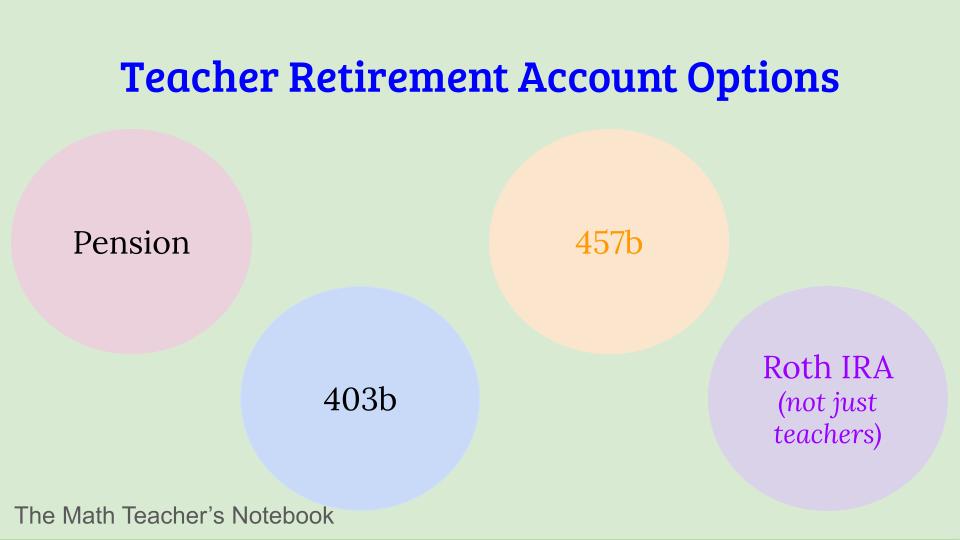
Let’s talk about the retirement system a public school teacher may be enrolled in when employed. As public employees, we may have access to our own retirement system, which depends on the district and state you work for. I teach in California, so I am enrolled in the California State Teachers Retirement System or CalSTRS for short. I’m not familiar with other school’s or the state’s retirement system, as I’ve only taught in CA, but each district and state have their own rules. A percentage of each paycheck is withdrawn to support our retirement system; you will need to become familiar with reading your paycheck to identify the percentage that is withdrawn. The money deducted is pre-taxed, each district has rules of how much a retired teacher will earn based on their age and numbers of years of service at retirement. Know your date of hire and the rule you fall under, become familiar with the website your retirement system uses, and attend any free workshops your retirement system offers. I began attending webinar workshops around year 15, mine are held online with a group of people, and the topics of the webinar vary and are organized by where in your career you are: early, mid, or close to retirement. In CA, they are held throughout the school year, summers included. The formulas of retirement are explained and there is opportunity to ask questions. The presenters also explain an optional account that we can sign up for as educators, the 403b.
The 403b is a retirement account that teachers have access to, and where we open the account depends on which vendor(s) your school district has approved. My state has a website, https://www.403bcompare.com, where we can look up the vendors available to you based on your school district. The site shares the fees, on average, associated with each vendor. There is another website, https://403bwise.org, which shares information about 403b and 457b retirement accounts, that I highly recommend you bookmark and read often. 403bwise is a nonprofit organization that shares guides on their website and a podcast supporting teachers with learning about retirement accounts. You can read about other teachers’ experiences, learn about the prices of the fees by vendors, and If you want to use a certain vendor, but your school district doesn’t work with them, 403bwise has resources to support you in getting them authorized as an approved vendor for your district.
Another account teachers have access to is a 457b. Teachers can open this account in addition to a 403b, if and when you are able to max out one of your retirement accounts, or if you prefer having a 457b instead of a 403b. The Internal Revenue Service (IRS) announces the annual maximum contribution to retirement accounts, based on your age, and once you have created a budget for your expenses, you can identify how much money you can afford to invest in each of your retirement accounts. Something to find out is if your district offers Roth accounts for these retirement accounts. Roth means your contributions will have been taxed, and the money you withdraw in the future will not be taxed. The 403b and 457b have different rules of when you can begin withdrawing the funds, which is why some people prefer one account or another. Contribute to one or both accounts, the choice is yours, based on your budget and retirement goals. I contribute to both accounts, I opened a 403b in my third year of teaching and a 457b around year 15, but my main account is a 457b because I can withdraw from it as soon as I retire from my employer, meaning I don’t have to wait until I’m a certain age to withdraw and I avoid paying 10% penalty tax.
There’s also a retirement account called a Roth IRA, and it’s not just for teachers. This account can be opened with any vendor, your school doesn’t decide where you can invest your money in, and you can open an account and begin to contribute to it as soon as you generate income and file your income taxes. There are rules about who can contribute based on your income, my teacher salary doesn’t reach the maximum, and the IRS also sets an annual maximum contribution, based on salary and age. As I mentioned before, Roth accounts contain money that has already been taxed and will not be taxed at withdrawal. The IRS also offers what they call catch-up contributions, where your annual maximum contribution is higher due to being 50 years or older, and this is for the 403b and 457b (if your employer allows it so find out), and Roth IRA.
Growing up, I knew about the stock market, but I didn’t know how to buy stock or invest. Life kept moving and I didn’t take the time to learn. In my third year of teaching, representatives from financial companies came to my school campus, offered us free food, and visited us during our conference periods or after school to sign us up for a retirement account, mostly the 403b. I knew I wanted to invest, but I didn’t know how to start, so I trusted them because I thought they were experts with finance. I later learned that I elected to open a 403b account with vendors that charged high fees and that my school district doesn’t allow these representatives on my campus anymore. Since I can’t go back in time and undo my financial mistakes and people say learn from your mistakes, I’m here to tell you what I tell my students, to learn from the mistakes of others. Take the time to learn about which vendors offer the lower fees and what’s best for you to prepare for retirement. People debate about which retirement accounts you should contribute to, pre- or post-tax, but I say start investing today. Remember, these retirement accounts are optional, you don’t have to sign up for them, but if you want to create opportunities for yourself in the future and retire when you want to and not continue to work when you don’t want to or unable to, then I highly recommend learning about these retirement accounts and opening one or two, for yourself.
As a math teacher, I enjoy learning and discussing finance and I encourage new teachers on my campus and that I work with to open an account. Let me know if you’re interested in learning more about retirement accounts.